
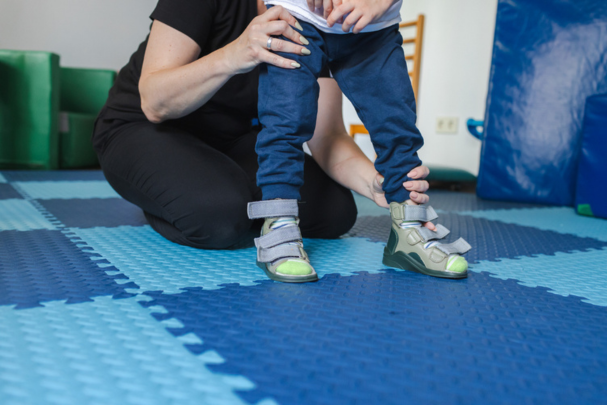
Most parents notice something is off before they have a name for it. Their child trips more often than other kids, walks with their feet unusually wide apart, or loses their balance on surfaces that don’t trouble other children. When a doctor finally puts a name to it, that name is often ataxic gait.
Understanding what ataxic gait is, why it happens, and what can be done about it helps families move from confusion to action. For children with ataxic cerebral palsy, recognizing these walking challenges early can make a real difference in treatment and progress.
What Is Ataxic Gait?
Ataxic gait is an unsteady, uncoordinated walking pattern caused by damage to the cerebellum, the part of the brain that controls balance, timing, and precise movement. The cerebellum acts like the brain’s GPS for movement, constantly sending signals to keep the body upright and on track. When it isn’t working properly, those signals don’t arrive in the right order or with the right force, so the body struggles to stay balanced and move smoothly.
The word “ataxia” comes from the Greek for “without order,” which describes the movement well. Steps may vary in length and timing. The child may sway or lurch slightly with each one. Walking looks unsteady, and it often is.
Why Children Walk with Their Feet Wide Apart
Children with ataxic gait typically walk with their feet set wider apart than normal. This wider stance is the brain’s way of compensating for poor balance, essentially building a broader base of support to reduce the risk of falling. Even so, the walking still looks unsteady.
The cerebellum controls something called proprioception, the body’s ability to sense where its limbs are in space without looking at them. When that system isn’t working well, the body can’t make the small, constant adjustments that normal walking requires. Every step becomes a balancing act, and that takes real effort.
This is why children with ataxic gait often tire more quickly than their peers. Walking isn’t automatic for them. It requires active focus, and that’s physically and mentally exhausting over time.
Ataxic Gait and Cerebral Palsy
Ataxic cerebral palsy is the least common form of CP, accounting for roughly 3.8% of all cases. It develops when the cerebellum is damaged during brain development, typically before, during, or shortly after birth. While other forms of CP often involve stiff muscles or uncontrolled movements, ataxic CP is primarily a coordination problem. The muscles themselves may be normal, but they don’t receive the precise timing signals they need to work together.
The result is an ataxic gait, along with other coordination challenges affecting the whole body.
It Affects More Than Just Walking
Ataxic gait is the most visible sign, but it’s part of a bigger picture. Children with ataxic CP often struggle with:
- Reaching for objects accurately, frequently overshooting or undershooting
- Tasks that need both hands working together, like clapping or buttoning a shirt
- Tremors during purposeful movements, where the hand shakes most when it’s trying to do something precise
- Activities that involve judging distance or depth, such as stepping off a curb or catching a ball
- Clear speech, because the same coordination problems that affect walking can affect the muscles used for talking
Each of these challenges connects back to the same source: a cerebellum that isn’t sending the right signals at the right time.
Why Ataxic Gait Is Hard to Treat
Unlike muscle tightness, which can be addressed through stretching, therapy, or, in some cases, surgery, ataxic gait comes from the brain’s signaling process. The damage to the cerebellum itself cannot be reversed. That makes treatment more complex because the goal isn’t to fix a single tight structure, but to help the brain and body build new movement patterns.
The good news is that children’s brains are remarkably adaptable. This quality, known as neuroplasticity, allows the nervous system to develop new pathways and workarounds when the primary ones aren’t working well. Early, consistent therapy takes advantage of this adaptability, especially in young children whose brains are still developing rapidly.
How Therapy Helps Children with Ataxic Gait
Physical therapy is the main treatment for ataxic gait in children with cerebral palsy. Therapists use specific methods designed to improve balance, coordination, and the efficiency of the child’s movement.
Balance training is central to this work. Therapists guide children through activities on different surfaces, including foam pads, wobble boards, and uneven ground, to challenge the balance system in a safe, controlled way. Over time, these challenges build the body’s ability to respond to instability more quickly and with more confidence.
Gait training focuses on the walking pattern itself. Treadmill work, parallel bar exercises, and guided walking practice help children develop more consistent movement. The goal isn’t a “normal” gait but one that works well for that child and reduces the risk of falls. You can read more about the range of mobility challenges children with CP face and how they’re addressed.
Occupational therapy targets the coordination challenges that affect daily life beyond walking, from handwriting and self-care tasks to the fine motor skills needed in school. For children whose speech is affected, speech therapy works on the oral coordination needed for clear communication.
Assistive devices such as ankle-foot orthoses (AFOs) can provide additional stability while walking, and weighted tools can reduce tremors during fine motor tasks.
What Families Can Do
Progress with ataxic gait comes from consistency. Therapy sessions build a foundation, but the repetition that drives lasting change often happens at home, woven into daily routines. Simple activities, like walking on different textures, practicing reaching games, or working on balance during play, reinforce what therapists are building in clinical sessions.
Early intervention matters, too. The CDC emphasizes that the earlier a child begins targeted treatment, the more the brain can develop the compensation strategies that make a lasting difference. If your child also shows signs of other co-occurring conditions, a broader evaluation is worth pursuing. Research shows that children with CP are nearly seven times more likely to also receive an autism diagnosis, so a full picture of your child’s needs leads to a better care plan.
When coordination and balance challenges are more severe, surgical options may also be part of the conversation. Cerebral palsy surgery can address secondary issues, such as hip problems or muscle contractures that develop over time and make movement even harder.
Located in Tampa, Florida, Children’s Cerebral Palsy serves families throughout the Tampa Bay area and across Florida. Dr. Siambanes and his team offer thorough evaluations and individualized treatment planning to help children with ataxic gait move with greater confidence and independence. Contact us to schedule a consultation.